
If you own a commercial building in East Peoria or maintain a facility in Morton, you know that a flat roof is a different beast than a residential pitched roof. It faces constant exposure, standing water, and the thermal shock of Illinois seasons.
When it comes time to replace that roof, you are usually presented with an alphabet soup of acronyms. The two most common contenders? TPO (Thermoplastic Polyolefin) and EPDM (Ethylene Propylene Diene Monomer).
At Paws Roofing Contractors, we install and repair both systems across Tazewell County. Here is a breakdown to help you decide which membrane is right for your building.
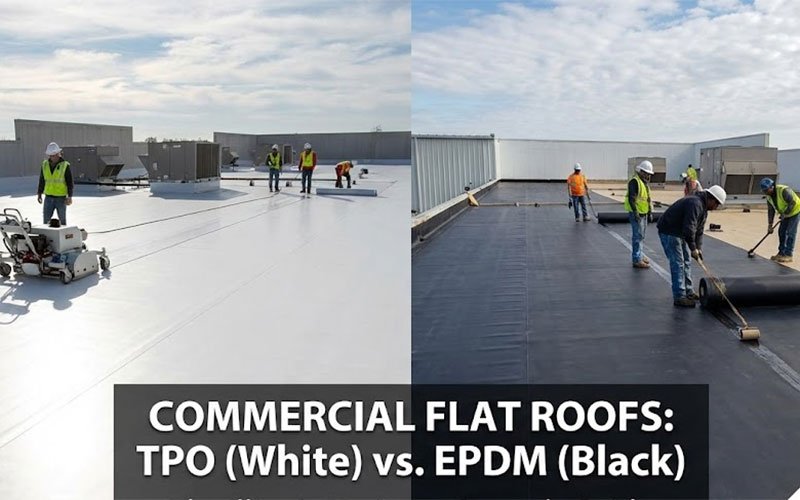
1. The “White Roof” (TPO) vs. The “Black Roof” (EPDM)
The most obvious difference is color, and in the Midwest, that matters for energy efficiency.
- TPO (White): TPO is typically white and highly reflective. In the scorching Illinois summer, it reflects UV rays away from your building. This can significantly lower your cooling costs, making it a favorite for buildings with heavy air conditioning loads (like retail stores or offices).
- EPDM (Black): EPDM is traditionally black. It absorbs heat. While this can add to cooling costs in July, it can actually help lower heating costs in January by absorbing winter sun.
2. Seam Strength: Welded vs. Glued
A flat roof is only as strong as its seams. This is where TPO often has the edge.
TPO seams are heat-welded. We use a robotic welder that superheats the material to over 1,000°F, fusing the two sheets together. The seam actually becomes stronger than the membrane itself. It creates a monolithic (one-piece) skin over your building.
EPDM seams are glued (taped). We use a special primer and seam tape to bond the rubber sheets. While modern adhesives are incredibly strong, they can eventually dry out or shrink over 20-30 years, making the seams the most common failure point on an older rubber roof.
3. Puncture Resistance
Does your roof see a lot of foot traffic? Do you have HVAC units up there that require monthly maintenance?
If so, EPDM (Rubber) might be the better choice. It is more flexible and handles hail impact and foot traffic exceptionally well without cracking. TPO is stiffer; while it is tough, it is slightly more prone to punctures from dropped tools or sharp objects if not properly protected with walk pads.
4. Chemical Resistance
If your business is a restaurant or industrial facility that vents grease, oils, or chemicals onto the roof, you need to be careful.
TPO is highly resistant to chemicals, grease, and animal fats. EPDM can swell and deteriorate if exposed to oil or grease. For restaurants in Peoria, we almost always recommend a TPO system (or a specialized grease-guard system) to prevent rapid decay.
The Bottom Line for Peoria Business Owners
There is no “bad” choice here—only the right choice for your specific building.
- Choose TPO if: You want energy savings in the summer, you have grease vents, or you want the peace of mind of welded seams.
- Choose EPDM if: You want a time-tested material (rubber roofs have been around for 60 years), your roof sees heavy winter snow, or you are looking for the most budget-friendly installation.
Don’t gamble with your commercial asset. Call Paws Roofing for a free commercial roof audit. We will core-cut your existing roof, inspect the decking, and recommend the system that fits your budget and your business needs.
Paws Roofing Contractors Corp
Serving East Peoria, Washington, Morton, and Pekin.
Address: 2813 N Main St, East Peoria, IL 61611
Phone: +1 866-712-0356
Website: https://pawsroofing.com/