
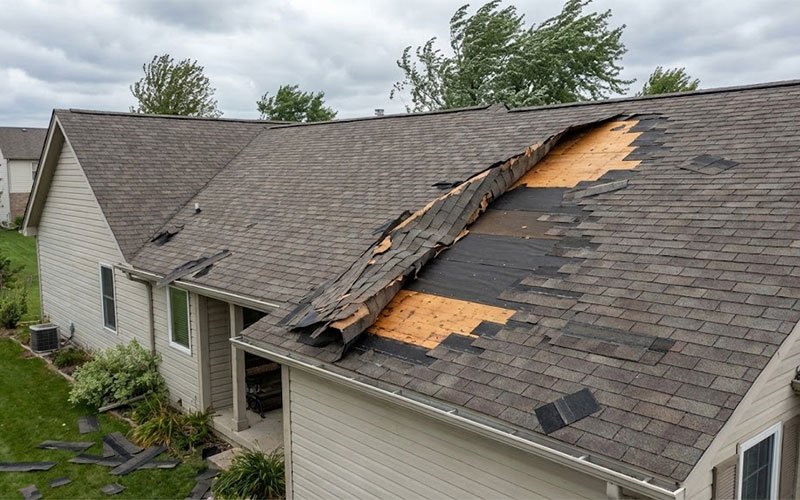
Living in Central Illinois, we get used to the wind. Whether it is a spring thunderstorm rolling through Washington or just a blustery November day in East Peoria, our homes are constantly being buffeted by gusts.
Most homeowners assume that unless a tree falls on their house, their roof is fine. But there is a silent killer of asphalt roofs that starts with just a single loose tab. In the roofing industry, we call it the “Zipper Effect.”
At Paws Roofing Contractors, we want to help you spot this damage early—before a small patch of missing shingles turns into a major interior leak.
What is the “Zipper Effect”?
Standard “3-tab” asphalt shingles are installed in rows. They rely on a strip of adhesive (tar) to seal them to the shingle below. When that seal fails—due to age, improper installation, or extreme cold—the shingle becomes loose.
The next time a 40+ mph wind gust hits your roof, it lifts that single loose tab. Instead of just ripping that one shingle off, the wind gets underneath it, creating an air scoop. This upward pressure lifts the shingle next to it, then the next one, and the next.
In seconds, an entire section of your roof can peel back exactly like a zipper, exposing the wood decking to rain. We often see this happen in the middle of a storm, leaving the home defenseless while the rain is still falling.
The Hidden Damage: “Creased” Shingles
Here is the scary part: sometimes the wind lifts the shingles, but they don’t rip off. They flap up, bend backward, and then lay back down when the wind dies.
From the ground, your roof looks fine. But up close, those shingles are ruined.
When an asphalt shingle bends backward, it creates a crease across the top. This crease fractures the fiberglass matting inside the shingle and dislodges the protective granules. It’s like bending a credit card back and forth; it might not snap immediately, but it is structurally broken. The next time it rains, water will seep right through that stress fracture.
The Solution: 3-Tab vs. Architectural Shingles
If your home was built 15+ years ago, you likely have “3-tab” shingles. These are flat, single-layer shingles that are typically rated for winds of only 60 mph.
In Peoria, we regularly see gusts higher than that. This is why we almost exclusively recommend upgrading to Architectural (Laminated) Shingles.
- No Tabs: They are constructed as one solid, laminated piece, so there are no individual tabs for the wind to catch.
- Weight: They are significantly heavier, helping them stay flat during storms.
- Wind Rating: Most modern architectural shingles are rated for 110 to 130 mph winds.
Don’t Wait for the Leak
If you find shingles in your yard after a storm, or if you see a dark line running across the top of your shingles (a sign of creasing), do not wait.
Call Paws Roofing. We are experts at identifying wind damage that insurance adjusters sometimes miss. We can provide a free, honest assessment of whether your roof needs a simple repair or if it is time to upgrade to a wind-resistant system.
Paws Roofing Contractors Corp
Serving East Peoria, Washington, Morton, and Pekin.
Address: 2813 N Main St, East Peoria, IL 61611
Phone: +1 866-712-0356
Website: https://pawsroofing.com/